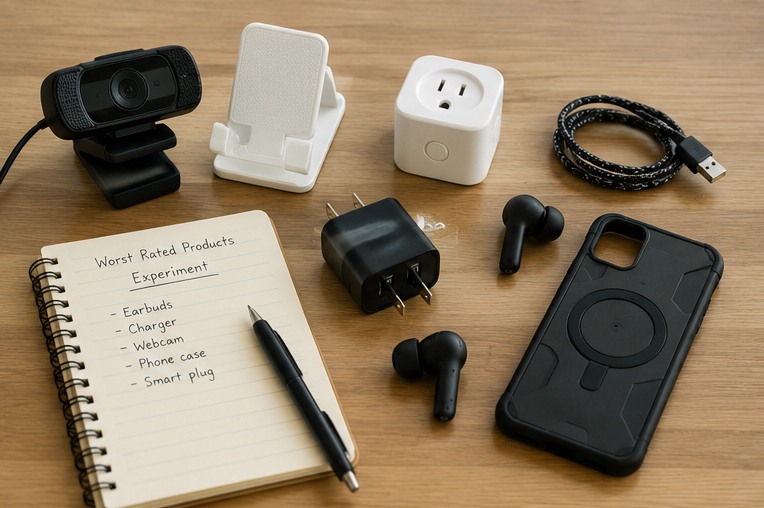
Everyone shops by star ratings and nobody entirely trusts them, which is a strange way to live, so I ran the experiment that settles it. In five everyday categories, I bought the worst rated product I could find from listings with at least a few hundred reviews, spending around $120 in total, and used each one for a month alongside a well rated equivalent. The question was simple. Do bad ratings reliably predict bad products, and by extension, do good ratings mean anything at all?
The answer turned out to be yes, no, and something more useful than either.
What I Bought and What Happened
Category
Rating
What a month revealed
Wireless earbuds
3.2 stars
Deserved worse, failed in three weeks
Fast charger
3.4 stars
Slow, ran hot, deserved its rating
Webcam
3.5 stars
Fine hardware, terrible software, rating fair
Phone case
3.6 stars
Perfectly decent, punished for shipping issues
Smart plug
3.3 stars
Good device, sunk by a bad app update since fixed
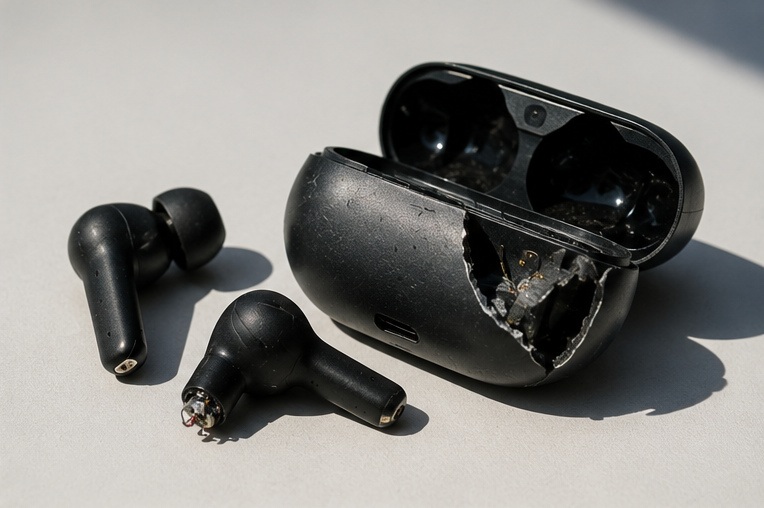
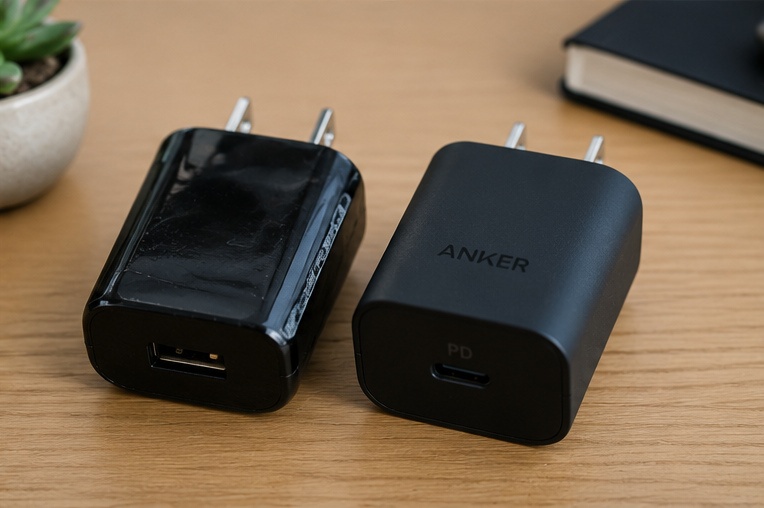
Two products deserved their bad ratings completely. The earbuds crackled from day one, held a charge for barely two hours, and one bud died entirely in week three, a lifecycle that made our blind sound test's $25 pair look premium. The charger delivered a fraction of its claimed wattage and became worryingly warm doing it, exactly as its angriest reviews warned.
Two products were victims of circumstance. The phone case fit perfectly and has protected a phone through a month of ordinary abuse, and reading its reviews closely revealed the crime it was punished for, which was arriving late or in the wrong colour, sins of a marketplace seller rather than the object. The smart plug told the most modern story, since its one star avalanche traced to a single terrible app update months earlier, long since fixed, leaving a good device wearing a bad season's rating forever.
The webcam split the difference, being competent hardware chained to software that fought me at every step, which is a genuine product flaw that the rating fairly captured even though the picture itself was fine.
What the Experiment Actually Teaches
The score alone is a blunt instrument, but it is not a random one. Below roughly 3.8 stars on a high volume listing, something real is almost always wrong, and my two genuine failures both lived down there. The useful skill is diagnosing what is wrong, because the causes are not equally disqualifying. Reviews complaining about the product failing, dying, or underperforming describe the object you will receive. Reviews complaining about delivery, packaging, sellers, or a since patched app describe a moment in the product's retail life, and those complaints drown good products regularly.
The diagnosis takes two minutes. Read the recent one star reviews first, not the five star ones, and look for repetition, because ten strangers describing the same failure in the same words is data, while scattered unrelated complaints are noise. Check whether the criticism clusters in a time period, which signals a bad batch or bad update rather than a bad design. And weight verified purchases on the exact model, since ratings on many listings pool together different colours, sizes, and even generations of a product, letting an old model's sins haunt its replacement. We cover the full method of reading reviews upside down in our companion piece on why one star reviews are more useful than five star ones.
The five star side deserves matching suspicion for the opposite reason. Perfect scores on young listings with vague, gushing, oddly uniform reviews are the signature of manipulation, and the categories where my worst rated products came from, meaning cheap electronics from unknown brands, are exactly where purchased praise concentrates. A 4.3 with a thousand reviews and articulate complaints is a far safer bet than a 4.9 with eighty reviews and none.
So can reviews be trusted? Collectively, cautiously, yes, in the way weather forecasts can. The rating tells you it might rain. Reading the actual complaints tells you whether to cancel the picnic or just bring a jacket.
Frequently Asked Questions
What star rating should I treat as a red flag? On listings with hundreds of reviews, treat anything under 3.8 as a signal to investigate and anything under 3.5 as a signal to walk away unless your reading clearly shows non product complaints. On listings with few reviews, the score means little in either direction.
Are five star reviews ever useful? Occasionally, for learning what a product is like to live with from long detailed ones. As a trust signal they are the least useful tier, being the easiest to buy, the most emotional, and the most likely to be written on day one before anything has had time to fail.
How can I spot fake reviews? Look for clusters of short, vague praise posted in tight time windows, reviewers with histories of reviewing one brand, and enthusiasm about features the product does not have. Free analysis tools exist that grade listings for review authenticity, and they are worth the paste of a URL on any unknown brand purchase.
Why do good products sometimes have terrible ratings? Shipping failures, marketplace seller behaviour, bad batches, and app problems all pour into the same score as genuine product quality. This is the central flaw of the star system and the reason the reading matters more than the number.
Do ratings work differently for cheap products than expensive ones? Yes, in an important way. Expensive products attract experienced reviewers and professional coverage that disciplines the listing, while the under $30 tier is where both fake praise and misdirected anger concentrate, making raw scores least reliable exactly where people lean on them most.
What is the single best habit for review reading? Sort by most recent rather than most helpful, then read a page of one star and a page of three star reviews. Recency defeats the haunting of old models and old app versions, and three star reviews are consistently the most honest text on any listing, written by people with no axe to grind in either direction.
We use cookies to see which reviews and buying guides readers find useful, so we can keep improving them. Accept analytics cookies, or carry on with essential ones only. See our Cookie Policy.













 Get it on
  Download on the